What are subharmonics, and why you do not hear them as pitch
Everyone knows harmonics: overtones, whole multiples above the fundamental. A subharmonic is the reverse. Not a multiple above but a division below. Half the frequency is exactly one octave down, and that is the division audio is almost always talking about.
The arithmetic of it
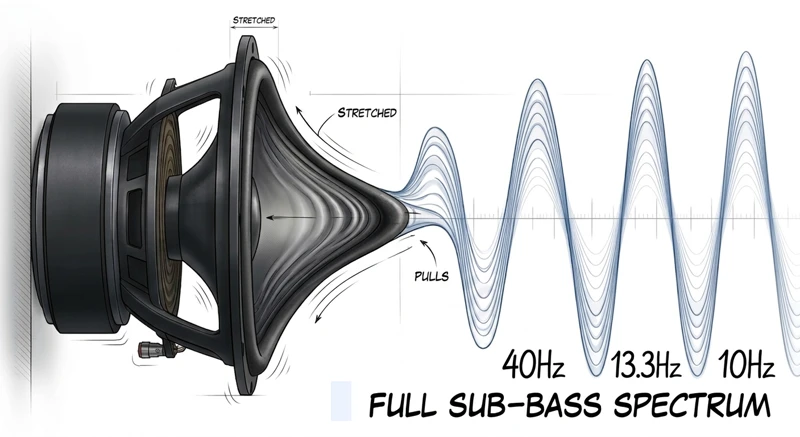
A harmonic is the fundamental times a whole number: 40 hertz gives 80, 120, 160. A subharmonic is the fundamental divided by a whole number: 40 hertz gives 20, 13.3 and 10. Dividing by two is one octave down, and musically that is the only division that always agrees with what is already playing. Which is why nearly every device in this corner does exactly that.
Why you do not hear it as pitch
Human hearing runs to 20 hertz in theory, but pitch disappears long before the sound does. Below roughly 30 hertz you can no longer tell which note is playing, you only notice that something is there. Below 20 hertz your body takes over from your ears entirely. A subharmonic down there adds no melody, it adds weight.
Why those tones are missing from your recording
Mastering filters out everything below roughly 30 hertz. It saves headroom, keeps the mix clean and stops small speakers from rattling. Film does not do this, because it has a dedicated channel for it. Which is why your subwoofer works hard during a film and stays quiet during music.
Analogue division against digital arithmetic
The classic units of the eighties did this with analogue divider circuits. They work, but they put colouration and noise into the signal path. With a purpose-built DSP design you can decide exactly which harmonic content to leave out, so what remains is not an audible tone but a supporting foundation. The range runs from 40 hertz down to 10 hertz.
It is not a bass boost and not an octave pedal
A bass boost makes louder what is already there. A guitar octave pedal tracks a single note and puts an audible tone below it. A subharmonic processor works on the whole signal at once and puts something back in a region where pitch no longer exists.
What you need to notice it
A subwoofer that genuinely reaches low, and a room that can take it. Play a sweep from 100 hertz down to 20 hertz. If you still feel or hear something at 30 hertz, a subharmonic processor is worth it for you. If nothing happens below 45 hertz, the limit is your speaker and not your music.
A subharmonic being generated, in a real system.

The Mini SubHarmonics generates those subharmonics in stereo, with a purpose-built DSP design, for 199 euro. Handbuilt in small batches and shipped from the Netherlands.