dbx 120A alternative: what to use now the subharmonic synthesizer is gone
The dbx product page says it in the title itself: 120A, discontinued, subharmonic synthesizer. Thomann files it under Legacy. The page stays online for the manual and for support, as those pages tend to, but the unit is not coming back. Used ones surface between 124 and 281 euro. And still it is searched for hundreds of times every month.
What the 120A did
The 120A was a subharmonic synthesizer: it analysed the incoming signal and generated new tones exactly one octave below it. Two adjustable bands, 24 to 36 Hz and 36 to 56 Hz, plus a separate low frequency boost. Analogue circuitry in a 19 inch rack, designed for PA systems and clubs.
Why people still look for it
Because the problem was never solved. Modern recordings and masters filter out or heavily attenuate everything below roughly 30 Hz. Your subwoofer is simply given nothing to work with on music, while films keep it busy. That gap becomes obvious the moment you own a capable sub, and then you start searching.
What is different about the Mini SubHarmonics
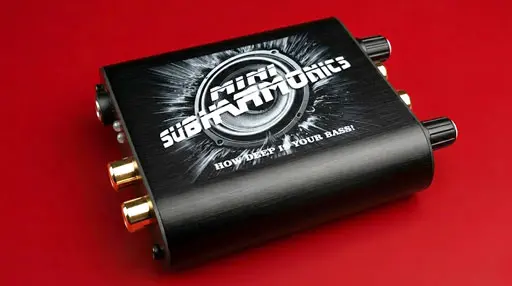
We solve the same problem from a different starting point. The 120A is analogue and creates an audible octave below the existing low end. We filter the harmonic content out of the sub range instead, so what remains is not a tone but a supporting foundation. You do not hear it as pitch, you notice it as physical presence. The audible bass is left alone: nothing is made louder, something is put back that had been removed. And it reaches deeper: the lowest band of the 120A starts at 24 hertz, the Mini builds the sub range from 40 hertz all the way down to 10 hertz.
Where people end up now
Anyone who wants one is left with the used market: Reverb, eBay, the occasional listing. Studios and producers have largely moved to plug-ins that do something similar in software. That works fine inside a computer, but not when the music comes out of an amplifier, an AV receiver or a car. There is nothing there to load a plug-in into. What is left is hardware that fits between the cables.
The differences, side by side
The 120A is analogue, the Mini is digital with its own DSP design. The 120A is a rack unit, the Mini is 70 by 60 by 30 millimetres. The Mini runs on 12 volts, so it works in a car as readily as in a home system. Effective latency stays below 1 millisecond, which makes it usable live. And it is stereo in a single enclosure, where comparable solutions are often mono and bought per channel.
What we are not
Not a bass booster and not an equaliser. A bass booster makes existing bass louder; if there is nothing below 40 Hz in your music, boosting leaves you with nothing. We add what is missing, below the audible range, without changing the character of the music.
The Mini SubHarmonics in a real system. The indicators respond in real time to the sub-bass being generated.

The Mini SubHarmonics is 199 euro, handbuilt in small batches and shipped from the Netherlands. Ships worldwide.