Feel the bass that was always missing
Most music lacks content below 50 Hz. Not because it's bad, but because it was never recorded there. The Mini SubHarmonics generates those frequencies in real time. No software. No plugins. Just connect and feel it.
★★★★★ 4.7 / 5 · Read 9 reviews →
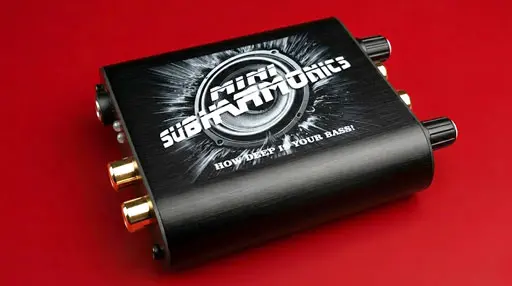
See what your speakers are missing
Watch the Mini SubHarmonics in a real audio setup. The LED indicators react in real time as sub-bass is generated. Bass you can see, and more importantly, feel.
🎧 Best experienced with a subwoofer or quality headphones.
How Deep Is Your Bass?
Press play. Then switch.
Both tracks are the same recording. One original, one with SubHarmonics processing. Switch while playing to hear the difference at the exact same moment in the track.
💡 Most noticeable on kick drums, bass lines, and low synths.
Reviewed on The Hans Beekhuyzen Channel
Hifi journalist Hans Beekhuyzen (105,000+ subscribers) tested the Mini SubHarmonics in his reference setup.
▶ Full review · 11 minutes
Click any quote to jump straight to that moment in the video.
The missing octave, recovered
For every low frequency in your music, the Mini SubHarmonics generates a tone exactly one octave lower. Mathematically precise and fully controllable.
Also known as a Subharmonic Processor — hardware that generates new sub-bass frequencies, not a bass booster.
Signal Detection
The DSP analyzes your incoming audio in real time, identifying frequency content in the low-end range.
Subharmonic Generation
For each detected frequency, a tone exactly one octave lower is generated. Mathematically precise and phase-aligned.
Controlled Blending
Gain and mix knobs let you dial in exactly how much sub-bass to add. Subtle enhancement or full rumble.
The spectrum doesn't lie
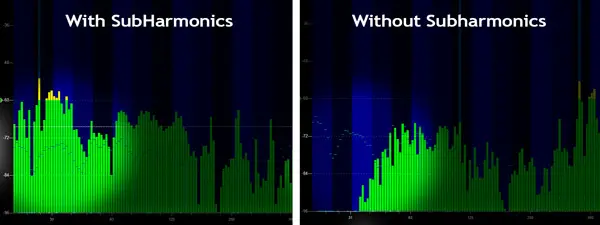
Left: with SubHarmonics processing. Right: without. The difference below 60 Hz is clearly visible and even more clearly audible.
Built for serious listeners
Home Cinema
Film soundtracks with the physical weight they were designed to have.
Car Audio & SPL
Runs on 9–14V DC. Real sub-bass on the road without changing your amps.
Studio & DJ
Hear how your tracks behave at sub-20 Hz frequencies during playback and mixing.
Synths & Sound Design
Add physical weight to 808s and bass synths. Electronic music comes alive.
Hardware with a single purpose: Pure Sub-Bass.
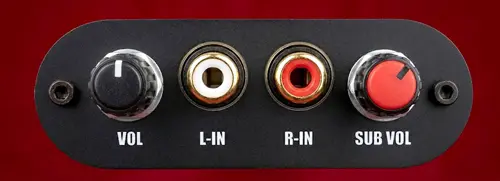
Connect via RCA, adjust the mix knob, and you'll immediately hear what your system was missing. No setup, no software, no nonsense.
Our shielded aluminum enclosure and internal power filtering deliver a –83 dB noise floor — even on a standard wall adapter.
✅ In stock — ships within 2 working days · 🔌 EU adapter + 12V car cable included
Mini SubHarmonics
A precision DSP device that generates the subharmonic frequencies your music is missing. No gimmicks. Just real, controlled sub-bass.
See it in action
Watch the hardware connected to a real setup. LED indicators respond to generated sub-bass in real time.
Hear it yourself
Same recording, with and without. Switch while playing to hear the difference at the exact same point.
Controls
| Input Gain | Adjusts input sensitivity to your source level |
| Sub Mix | Blends generated subharmonics into the output |
| LED Indicators | Audio overload warning — L+R channels |
The spectrum comparison
Left: with SubHarmonics. Right: without. The sub-bass region below 60 Hz shows a clear, measurable difference. Not a subtle tweak.
Works with your setup
Any system with line-level (RCA) outputs. If your system has RCA connections, the Mini SubHarmonics plugs straight in.
Full Specifications
Built with precision. Every parameter controlled, measured, and documented.
Audio Performance
| Subharmonic Range | 10 – 40 Hz |
| Input Range | 20 Hz – 20 kHz |
| Processing | 1 octave below input |
| Sample Rate | 48 kHz |
| Latency | ~1 ms (live-safe) |
| Noise Floor | ~-83 dB |
| Channels | Stereo L+R |
Connections
| Input | 2× RCA stereo (L+R) |
| Output | 2× RCA stereo (L+R) |
| Power | DC barrel 2.1mm |
Power Supply
| Input Voltage | 9 – 14V DC |
| Home Adapter | Included (EU) |
| Car Cable | 12V included |
Physical
| Dimensions | 70 × 60 × 30 mm |
| Enclosure | Aluminum + printed front |
| Built | Hand-assembled, Netherlands |
| Production | Small batches, each tested |
Controls & Indicators
| Input Gain | Rotary potentiometer |
| Sub Mix | Rotary potentiometer |
| Overload LEDs | L+R channel indication |
In the Box
| Mini SubHarmonics unit | ×1 |
| EU power adapter | ×1 |
| 12V car cable | ×1 |
| Quick start guide | ×1 |
Can your system go this low?
This video steps from 100 Hz down to 20 Hz, 10 seconds per frequency. Most systems drop out before 40 Hz.
100 Hz → 50 → 45 → 40 → 35 → 30 → 25 → 20 Hz
🎧 Subwoofer or headphones required.
Hans Scholtze
I've been fascinated by low frequencies for a long time. Not just the bass you hear, but the bass you feel. The physical weight of a film scene. The sub-20 Hz content in a synthesizer that your body registers before your ears do.
What I discovered is that most audio systems, even the good ones, never receive those frequencies. The source material doesn't contain them. Older recordings lacked the technology. Modern productions often omit them by choice.
The Mini SubHarmonics was my answer. Hardware with no latency, no driver installs, no software updates. A precise device that slots into any line-level signal path and adds the missing octave back in.
Everything is handbuilt in the Netherlands, in small batches. I test each unit before it ships. It only ships when it's right.
Designed to do one thing, and do it perfectly.
No software required
Zero dependencies. No drivers, no app, no cloud. Works the moment you plug it in.
Handbuilt, not mass produced
Small batches from the Netherlands.
No compromises
Low noise floor. Minimal latency. Aluminum enclosure. Built the way I'd want to receive it.
FAQ — Real Questions, Honest Answers
Questions from buyers, interested listeners and hi-fi enthusiasts.
How do I get deeper bass out of my subwoofer?
Most people think a bigger or more expensive sub will solve the problem, but in 90% of cases it's not the subwoofer itself. It's simply not in the recording. I built the Mini SubHarmonics because I had that exact problem myself. My sub did nothing on older music. The Mini calculates in real time what should have been in the sub-bass region (10 to 40 Hz) and sends it to your subwoofer. Result: your sub finally does what you bought it for.
My sub doesn't go deep enough, what now?
Test it yourself first: play a sweep from 100 Hz down to 20 Hz (there's a video of it on my site). Can you still hear it at 30 Hz? Good. Does it suddenly drop out? Then it's the sub itself, and buying a new one is the answer. But does it go deep enough yet you still miss the "punch"? Then it's the source material. That's exactly what the Mini SubHarmonics is built for.
How do I get more bass out of my music?
It depends on where the problem sits. First, play a sweep from 100 Hz down to 20 Hz. If it drops out somewhere below 30 Hz, the issue is your subwoofer or speakers, and an upgrade there will make the biggest difference.
But in 90% of cases the problem isn't the system, it's the music itself. Most recordings simply don't contain frequencies below 50 Hz. A bass booster or EQ won't help in that case — there's nothing to boost. All you're doing is making the existing higher bass louder, which often just sounds muddy. The Mini SubHarmonics does something different: it generates the missing sub-bass in real time, based on what is in your music. You get real depth added, not amplified mud.
Does the Mini SubHarmonics do bass boost?
Yes, but differently than you're used to — and that's where the real difference lies. A regular bass boost (on your amplifier, in an EQ, or via a bass booster app) makes the existing bass in your music louder. More volume, often also more mud and distortion. And if there's nothing below 40 Hz in the recording, there's still nothing below 40 Hz after boosting — you just hear the higher bass frequencies louder, often muddier.
The Mini SubHarmonics works fundamentally differently: it generates new sub-bass tones (10–40 Hz) that were never there, and mixes them in a controlled way. Hear 80 Hz in the music? It adds 40 Hz. Hear 60 Hz? It adds 30 Hz. The effect people search "bass boost" for — more and deeper bass you hear and feel in your hi-fi setup — you absolutely get. But clean, without distortion, and working even on music where regular boost has no effect.
What is sub-bass exactly?
Sub-bass is everything below 60 Hz. The part of the sound you feel more than you hear: an organ pedal in a church, a film explosion that hits you in the chest, an 808-drop in electronic music, the physical thump of a large kick drum.
Sub-bass has roughly two regions. Between 40 and 60 Hz is the "punch" — clearly audible, and where most decent subwoofers and larger speakers still perform well. Between 10 and 40 Hz is the "rumble" — where hearing turns into feeling, and where most systems (and most recordings) drop out.
Most music is missing exactly that deepest portion. Not because it's bad music, but because those frequencies were never captured during recording. The Mini SubHarmonics restores that range, targeting 10 to 40 Hz.
Is my subwoofer compatible with the Mini SubHarmonics?
Almost any active (powered) subwoofer with a line-level RCA input works. The Mini connects between your pre-out — from your amplifier, preamp or AV receiver — and the RCA input of your subwoofer. No drivers, no software, just route the signal through it.
What your sub does need to do is go low enough to reproduce the generated frequencies. A subwoofer that already collapses at 40 Hz won't produce 25 Hz, even when the Mini SubHarmonics sends those signals to it. Test first with a sweep from 100 Hz down to 20 Hz (video on the site): can you still hear or feel something at 30 Hz? Then your sub is compatible, and the difference will be clearly audible.
A passive subwoofer (without its own amplifier) won't work directly — it needs a separate amplifier first. Same goes for speakers with only speaker-cable inputs.
What's the difference between a bass booster and a subharmonic processor?
A bass booster makes existing bass louder. If there's nothing below 40 Hz in your music, there's still nothing after boosting. The bass just gets thick and muddy, no real depth. A subharmonic processor like the Mini creates new tones, one octave below what's already there. Hear 80 Hz? I generate 40 Hz alongside it. Hear 60 Hz? I add 30 Hz. So you get real depth instead of amplified mud.
Can I improve my subwoofer without buying a new one?
Yes, often you can. A good sub from a few years ago can technically reproduce sub-bass just fine, it's just not in the source. For €199 you add the missing frequencies, instead of spending hundreds of euros on a new sub that with the same source content still won't go deep. Trying this first is smart. If it doesn't work for your setup, just send it back via the Marktplaats buyer protection.
Can I connect it only to my sub?
Yes, that's actually a very elegant solution technically. Do you have a preamplifier with two pre-outs, or a separate sub-out? Send one to your regular amplifier (clean signal, nothing changed) and route the other through the Mini SubHarmonics to your active subwoofer. That way your main signal stays completely clean and the subharmonic only affects the sub. Works fine as long as it stays at line level.
Does the Mini SubHarmonics work with old recordings and LPs?
That's where it really shines. Tape recorders from the '70s and '80s lost almost everything below 50 Hz. Not because the music didn't have it, but because the technology couldn't capture it. Many classic albums are "empty" in the sub-bass region as a result. The Mini gives those albums back what they never had.
With turntables there is something to keep in mind though. A stylus in a groove always generates some rumble, especially below 30 Hz. That rumble is already in your signal, and the Mini SubHarmonics amplifies it along with everything else. That doesn't sound right, you get a thud in your sub that has nothing to do with the music.
The solution is simple: filter everything below 40 Hz with an EQ before the Mini SubHarmonics. The rumble disappears and the Mini then generates clean, new sub-bass based on what's actually in the music. So you get the best of both worlds: vinyl enjoyment without rumble, with the depth the recording itself never had.
With CD, streaming and digital sources you don't have this problem. There's no mechanical rumble there, so you can connect the Mini directly without a pre-filter.
How is it different from the old dbx subharmonic processors from the '80s?
True, dbx pioneered this technology. But those old analog circuits added audible coloration and noise. Quite charming for some hi-fi romantics, but not pure. The Mini SubHarmonics does the same principle with modern DSP technology: cleaner, quieter (-83 dB noise floor), and suitable for high-end systems. No vintage charm, but a transparent signal path.
What instruments actually play below 50 Hz?
In an orchestra: timpani, organ pedals, five-string double bass. In modern music: 808s, synth bass, sub-drops in electronic music. And in films: the entire LFE channel (explosions, door slams, rumble). But it's not just about what you can hear below 50 Hz, it's also about what you can feel. A lot of sub-bass registers in your body before your ears pick it up. That's what most music is missing.
Does this work for home cinema and films?
Yes, films benefit enormously from it. An AV receiver with a line-level pre-out for the subwoofer is ideal. Put the Mini in between and you get sub-bass down to 10 Hz where your film normally only reaches 40 Hz. Older films notice the difference the most. Make sure your sub and amplifier can also reproduce those frequencies, otherwise you're generating something you can't hear.
What is a DSP Subharmonic Synthesizer?
A DSP Subharmonic Synthesizer is hardware that uses digital signal processing to create new sub-bass tones based on what's already in your music. For each detected low frequency, the device generates a tone exactly one octave lower, mathematically precise and phase-aligned. The Mini SubHarmonics is my version of it: handmade in the Netherlands, in small batches, for €199.
What independent reviews are there?
Hans Beekhuyzen (105,000+ subscribers on YouTube) tested the Mini in his reference setup. His conclusion was that the music sounded "more live, more evolving". There are also several buyer reviews via Marktplaats and Ebay, readable on the order page. To date, not a single unit has been returned.
What's in the box?
The Mini SubHarmonics itself (aluminium 70×60×30 mm), an EU power adapter, a 12V car cable, and a quick start guide. Everything you need. Connect via stereo RCA and you're ready. No software, no drivers, no account to create.
Is there a software version or plugin for Roon, foobar or a DAW?
Yes, there are excellent software versions and plugins for generating subharmonic frequencies. But we chose hardware, and that's a deliberate choice. Software plugins always have latency, drivers and updates. They only work in one playback chain (Roon, your DAW, your phone app). Hardware works everywhere: streamer, CD player, turntable, AV receiver, anything with line-level RCA outputs. Connect once and you're done. No subscription, no "supported until 2027", no incompatible OS updates that break everything.
How do I get deeper bass in my hi-fi setup without buying a new subwoofer?
This is the question I designed the Mini SubHarmonics for. In most hi-fi setups the problem isn't the sub or the amplifier, but the music itself. Many recordings simply don't contain frequencies below 50 Hz. A new sub isn't going to fix that. The Mini SubHarmonics calculates the missing sub-bass in real time and sends it to your existing sub. For €199 you get deeper bass out of the same system. With audiophile setups the difference is most noticeable, because the rest of the chain is already clean and transparent.
Can you actually hear deep bass, or do you only feel it?
That's a fair question, and the answer is: both. The deep bass you actually hear sits roughly between 25 and 40 Hz. Below that, you feel it more than you hear it. An organ pedal in a church, a film explosion you feel in your chest, a bassline that makes the room come alive. That's the physical side of bass that most music is missing. The Mini SubHarmonics adds exactly the deep low end your system is ready for. Not for nice measurement graphs, but for the feeling that music finally moves you the way it should.
Get your Mini SubHarmonics
In stock. Ships from the Netherlands within 2 working days. Everything included.
incl. all accessories · ships in 2 working days
- Mini SubHarmonics DSP unit
- EU home power adapter
- 12V car power cable
- Stereo RCA input & output
- Hand-tested before shipping
Choose your platform:
📦 Ships from the Netherlands
🔌 EU adapter + 12V car cable included
What you receive
- Mini SubHarmonics unit — aluminum 70×60×30mm
- EU home power adapter (9–14V DC)
- 12V car power cable
- Stereo RCA in + out
- Quick start documentation
What others experience
Honest feedback from buyers. No marketing — just what people wrote themselves after a few months of use.
"Once you start using it, you can't go back."
"Nice compact little box and definitely an improvement for my subwoofer, which previously only worked with films and some music. That subwoofer is now finally really working with music."
"Personally I would have liked an on/off switch, but that aside. Older music is processed really well. Gives a lot of body. Even modern music that I thought already went pretty deep — the mini still adds some extra low end. And fortunately not over the top. All in all quite satisfied. My slogan for the mini: it can even make a poor sub sound surprisingly good."
"Especially with older recordings (the LP era, so to speak) this is a very welcome addition. I'm a real fan of clean, undistorted deep bass, and that's exactly what this unit restores. Mathematically it brings back the sub-bass that should have been there in the first place. It sounds really good and very musical. Music that already has plenty of sub-bass doesn't fall apart — really impressive. I saw a comment in another review that it doesn't contain a high end ADC and DAC, but that's something only people with €1000 interconnects will think they can hear."
"I'm using the SubHarmonics now for several months and I'm very pleased with it. I hear the low now as I have never heard it. It also depends on the equipment and headphones you use. It's unbelievable."
"Didn't know what I was hearing after connecting this beautiful device. Want that really 'fat, deep' sound? Then this device belongs in your audio system."
"The SubHarmonics has been running here continuously for weeks and continues to sound stable and pleasant; it only gets slightly warm. The compact form factor is convenient, although that also makes it feel slightly less luxurious. Still, I don't really want to listen without it anymore."
"I've been using the Mini SubHarmonics for a while and the difference is tangible — literally. Some bass you feel more than you hear, and that's exactly what this device is good at. One tip: make sure you have decent headphones or speakers, otherwise you'll still miss the effect below 30 Hz."
"The maker of the Mini Subharmonics is a true techie. What a top product. Simple to connect, solid device with the right knobs. Want to add a lovely touch of real sub-bass to your music, or an 'earthquake that moves your furniture'? Both are possible with the Mini Subharmonics. I didn't know what I was hearing! Deep deep low at both low and high volume levels. Excellent."