Digital bass restoration: putting back the low end mastering removed
Bass restoration is the tidy name for a simple problem. Modern recordings and masters filter out everything below roughly 30 Hz. Your subwoofer can reproduce it, but is never given it. A bass restoration processor works out what belonged there and puts it back.
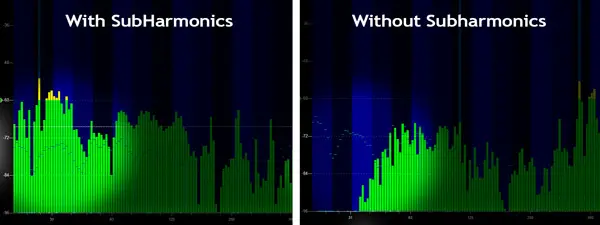
Why the low end is missing
Mastering removes the deepest bass. That is not carelessness: it saves headroom, keeps the mix clean and stops small speakers from rattling. Film does not do this, because it has a dedicated channel for it. Which is why your sub works hard during a film and stays quiet during music.
How restoration differs from boosting
A bass booster makes louder what is already there. If there is nothing below 40 Hz in your music, boosting still leaves nothing, only more level above it. Restoration adds what is missing and leaves the audible bass alone.
Why digital
The classic units in this category are analogue and add colouration and noise to the signal path. With a purpose-built DSP design you can decide exactly which harmonic content to leave out, so what remains is not a tone but a supporting foundation. You do not hear it as pitch, you notice it as presence. The range runs from 40 hertz down to 10 hertz, well below what most recordings still carry.
Car and living room
The Mini SubHarmonics runs on 12 volts and sits between line level in and out. That makes it equally at home between an AV receiver and an active subwoofer or in a car system. A home adapter and a 12V car cable are both in the box.
Stereo instead of mono
Comparable solutions are often mono and bought per channel. This one is stereo in an enclosure of 70 by 60 by 30 millimetres, with effective latency below 1 millisecond, so it can be used while playing live.
Point 03 above, but on screen. The indicators respond in real time to the sub-bass the DSP adds, while the audible bass is left alone.

199 euro, handbuilt in small batches, shipped from the Netherlands.